

And Jesus looked around and said to his disciples, “How hard it will be for those who have riches to enter the kingdom of God!” And the disciples were amazed at his words. But Jesus said to them again, “Children, how hard it is to enter the kingdom of God! It is easier for a camel to go through the eye of a needle than for a rich man to enter the kingdom of God.” And they were exceedingly astonished, and said to him, “Then who can be saved?” Jesus looked at them and said, “With men it is impossible, but not with God; for all things are possible with God.” Peter began to say to him, “Lo, we have left everything and followed you.” Jesus said, “Truly, I say to you, there is no one who has left house or brothers or sisters or mother or father or children or lands, for my sake and for the gospel, who will not receive a hundredfold now in this time, houses and brothers and sisters and mothers and children and lands, with persecutions, and in the age to come eternal life. But many that are first will be last, and the last first.”
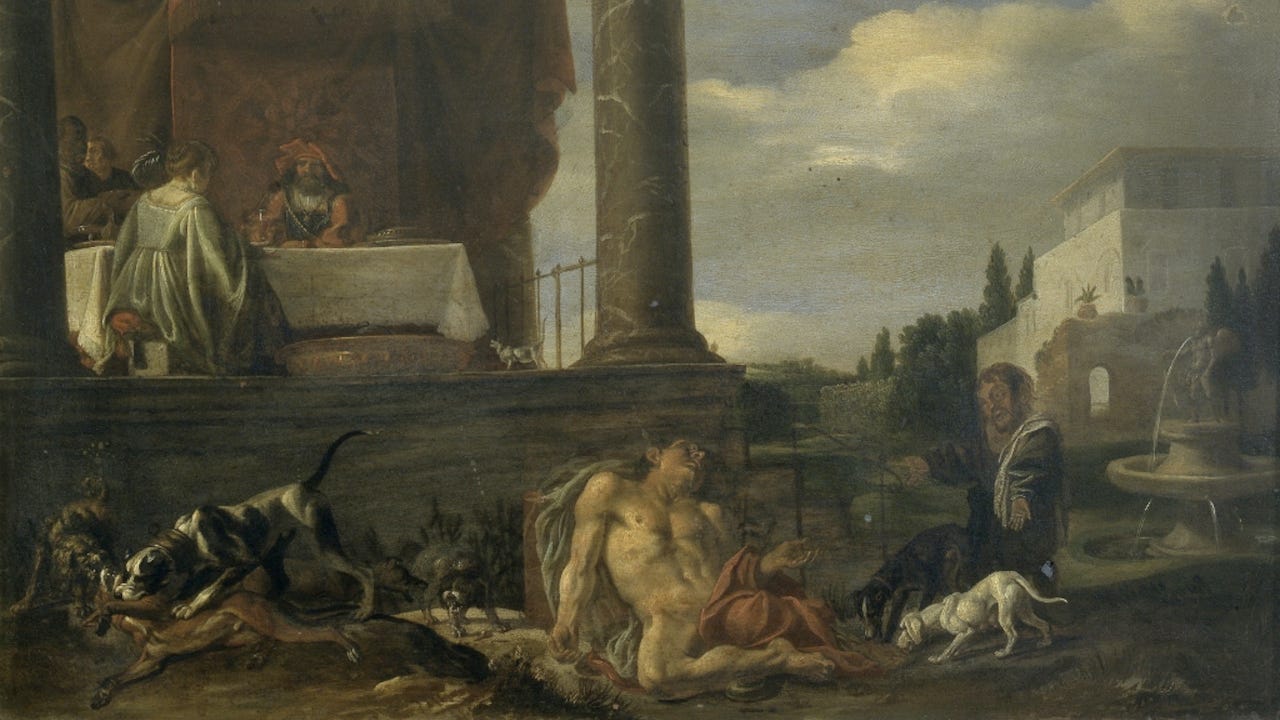
What does Jesus have against wealth and riches? Why does He say it will be hard for a rich man to enter the Kingdom of Heaven?
Should we not strive for excellence? Should we not always reach for success?
In the Sermon on the Mount, Jesus teaches us that we should not hide our light under a bushel. Rather, He teaches that we should be out there, putting all our works, all the fruits of our labor, on full display, that they may glorify God.
Are we supposed to do that and not be compensated? Is not the workman worth his wages?
Yet Jesus is quite explicit on the topic of wealth.
In Mark, just before Jesus gave this teaching on the perils of wealth to His disciples, He admonished the rich man who asked Him how to win eternal life, telling the rich man to sell all that he had, and give the money to the poor. We should note that, rather than embracing the directive Jesus had given him, the rich man went away dejected; he did not want to give up his wealth.
This story is repeated in Luke 18, with the rich man becoming a rich ruler of sorts.
In Matthew 6 Jesus teaches we should not acquire wealth here on earth, “where moth and rust consume and where thieves break in and steal.” Rather our focus must be on building up “treasures in Heaven”.
In that same passage, however, Jesus gives important nuance when He sagaciously observes that “where your treasure is, there will your heart be also.”
What is most important to us? Does it matter more that we do excellent work, or that we receive excellent pay in exchange for our work?
Jesus absolutely calls us to do the best we can, and the most we can, with whatever resources we have been given. That is the indisputable teaching of the Parable of the Talents, where the servants who put their resources to work were rewarded, while the servant who did not share his resources was punished.
If we work hard and make good use of our resources, we should expect—and Jesus teaches—that we will prosper. To some degree, we will grow rich. It is only when we make riches the priority that we encounter a spiritual dilemma.
It is helpful to a coherent understanding of these passages to recall that Jesus also teaches a few times that we should not worry, not even about what we will eat, and where we will sleep.
Worrying about how one will obtain the basic necessities of life is, of course, part and parcel of human nature. Despite His teachings, concerns about mundane world matters such as paying bills and holding down a job tend to dominate our thinking. We even valorize it, calling it “being responsible.”
Is it really responsible? Is that really how we should focus our efforts each day? Maybe it is, but Jesus invites us to share a different perspective.
Consider:
If we are focused on excellence as a service to God, will we not be reliably on time and productive at work, simply because that's what excellence entails? If we concentrate on doing all that we can do while at work, will we not do all that is expected and required of us, simply because the devotion to excellence automatically extends to cover those demands?
If, however, we are fretful and worried most about the paycheck, and someone seeks to pressure us into doing something unethical or even illegal, will our fearfulness make us more or less likely to do the wrong thing? Alternatively, if the money is all that matters to us, how likely are we to cut corners, perhaps even dangerous ones?
How certain could any of us be of the rightness of our choices if we are vulnerable to such pressures and temptations?
In similar fashion, what temptations come our way when our work leads us to build an audience and cultivate a following? Will we be swayed by other people's opinions of us and steered away from doing and saying the right thing in whatever circumstance? Will we compromise our actions for the sake of our audience?
What is most important to us? Do we want to be right or do we want to be popular?
I naturally desire my words to be seen and shared. I write both All Facts Matter and Peter's Proverbs because I want an audience among people. I want to be noticed in this world. For better or worse, that is my ambition.
Will I therefore alter my words specifically to appeal to more people?
Shall I deviate from the truths I see because popular opinion demands it?
Shall I instead speak my mind, popularity be damned? Shall I say what facts and evidence on the one hand, or Scripture on the other, reveal to me, no matter how people respond?
I like to believe I choose the latter course. I want to believe I bear true witness in all things.
I hope I do.
Yet I would be lying if I said I do not worry about how my words will be received. I want my audience to increase, not decrease. My dream is always to be able to support myself by my writings, a dream I have to realistically admit is not likely to happen anytime soon. I would be lying if I said that dream played no part in how I write or what I write.
Is the rich man in Jesus’ teaching more concerned with winning a following than bearing true witness? Is he more concerned with outward appearance than with inner light?
We cannot, of course, know all that is in any man's soul. We should not presume that merely because one is wealthy they are more concerned with worldly things than with Godly things.
However, we know from what is said about the rich man in Mark 10, and what is said about the rich king in Luke 18, that these men were very attached to their wealth. They wanted to be good men, but not at the price of their wealth.
Faced with the demands of righteousness, they cared more about their wealth than about God. Faced with choosing this world or the next, they chose this world.
Jesus warns of this very choice in Matthew 6:24, teaching us that “No one can serve two masters; for either he will hate the one and love the other, or he will be devoted to the one and despise the other. You cannot serve God and mammon.”
What is most important to us? Do we value our riches above our service to God?
Is it a given that rich people will value their riches above their service to God? A good argument can be made that those who flaunt their wealth certainly value that wealth above their service to God.
We cannot see into anyone’s soul. We can see the fruits of people who choose to live ostentatiously rather than modestly. We can see the works of people who put their own luxury and comfort first.
People can see our fruit as well, regardless of how we choose to live. People can see our works, regardless of what we think of luxury and comfort.
What is most important to us?
My prayer this day is that each of us will make service to God most important. My prayer this day is that each of us, when faced with the demands of righteousness, will choose service to God above worldly wealth. My prayer this day is that each of us will choose to bear Godly fruit rather than worldly fruit.
We can see the fruits of people who choose to live ostentatiously rather than modestly. We can see the works of people who put their own luxury and comfort first.
People can see our fruit as well, regardless of how we choose to live. People can see our works, regardless of what we think of luxury and comfort.
What is most important to us?
“And God is able to make all grace abound toward you, that you, always having all sufficiency in all things, may have an abundance for every good work.” - Corinthians 9:8
Put your thoughts and heart on serving God, and He will give you the means by which you can do good.
Bless you always, Peter, for addressing the perplexing matters in life.