

All your fortresses are like fig trees
with first-ripe figs—
if shaken they fall
into the mouth of the eater.
Behold, your troops
are women in your midst.
The gates of your land
are wide open to your foes;
fire has devoured your bars.
Nahum 3:12-13
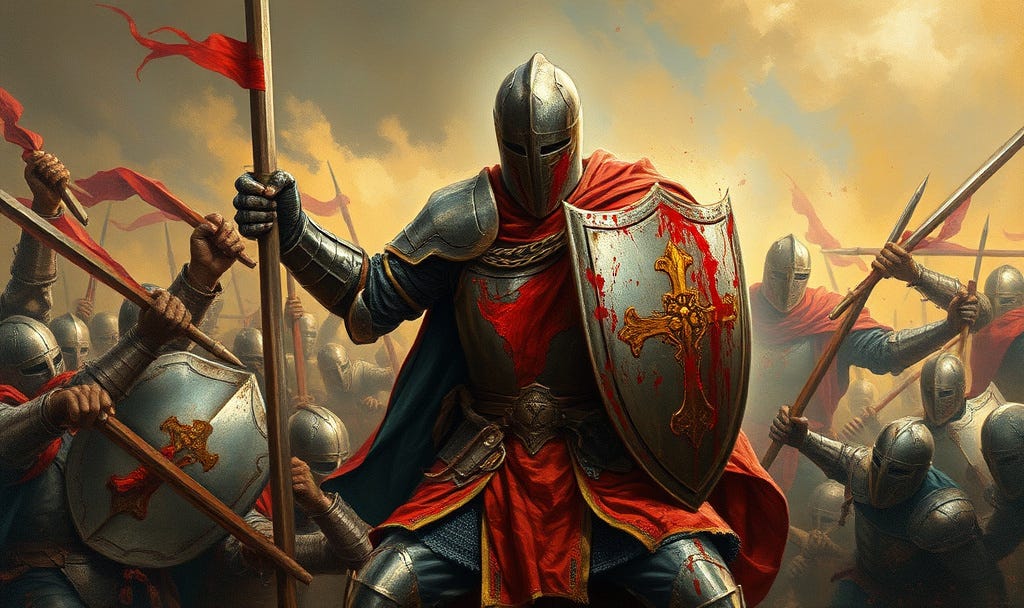
As a rule, we prize strength and power. From the myths and legends of antiquity to the comic book heroes of today, our heroic images have invariably been images of physical strength and physical power: Gilgamesh, Samson, Achilles, Heracles, Superman, Spider-Man, the X-Men, Rambo, Rocky, James Bond, Jason Bourne…we celebrate those who not only do, but who win.
As a rule, we want our political leaders to project strength and power. Donald Trump’s supporters cheer his flexing of American power on the world stage, while his detractors cast about for those who will summon the power and strength to defy him. Russian President Vladimir Putin long cultivated an “alpha male” image by being photographed shirtless and engaging in “manly” pursuits such as judo competitions.
We value strength. We value power. We generally desire both, but do we truly understand what they are?
Is Russia more powerful than Ukraine for having massed troops to invade? How strong are the Ukrainians for having held Russia to a stalemate seemingly against all odds?
Is America stronger because President Trump ordered Venezuelan President Nicolas Maduro seized and brought to stand trial in an American court?
Is the Iranian government of the Ayatollah Ali Khamenei more powerful for having suppressed once again the demonstrations and protests of Iranians? Are the Iranian people strong for having dared to protest against Khamenei?
What of the people currently protesting—and rioting—against ICE enforcement actions in Minnesota? Are they strong for standing against law enforcement? Are the law enforcement officers strong for persisting in their efforts in spite of the heated and even violent public opposition?
Narratives abound which argue the strength and power of all of these figures and peoples. Narratives abound which argue that all of these figures and peoples are, at their core, weak and feckless.
Which narratives are true? How would we tell?
How do we accurately apprehend the sources of strength and power, that we may summon them into our own lives?
We can rationally apprehend Ukrainian strength by one very obvious reality: they are still fighting Russia. Whatever else we might say about the country, the people, or their cause, they are still fighting, still holding Russia to a stalemate, still persisting against a foe which on paper is larger and stronger in almost every way.
How is that not strength?
We might be similarly be tempted to apprehend the Iranian regime as being strong by virtue of their continued existence. Yet we must also apprehend the consequences of their chosen responses to Iranian protests: having chosen to violently suppress the uprisings, they have little choice but to maintain a virtual stranglehold on the population. Their burden of governance is demonstrably heavier today than it was when the protests began.
It is a curious sort of power that can be held hostage to what others might do.
Many might be tempted to view the protesters in Minnesota as “speaking truth to power”. Yet there seems little indication that ICE is being at all dissuaded from pursuing their law enforcement duties, despite the increasing intensity of the protests as they turn into riots.
It is a curious sort of strength that fails to make much impact on others.
One thing we can see, whether we are looking at Ukraine, Iran, or Minnesota, is who is persisting, despite the forces arrayed against them.
Ukraine is certainly persisting.
Anecdotal reporting coming out of Iran certainly suggests the Iranian people are still protesting the regime despite a brutal crackdown which has claimed thousands of lives.
Iranians, it would seem, are persisting.
It is too soon to tell which side will persist in Minnesota, although the cadres of ICE agents sent to Minnesota have certainly shown no sign of holding back. They are still pursuing their investigations and detentions, despite the growing violence from the protesters-turned-rioters.
At the very least, ICE is so far persisting. Whether the protesters in Minnesota match their determination remains to be seen.
How are these various groups managing to persist even in the face of determined opposition?
Certainly one obvious answer is that they are convinced they are in the right. If what they are doing is the right thing, failing to persist must also be understood as the wrong thing.
The strength to persist can therefore easily be said to be found in doing the right thing. Strength comes from following God’s Law, and acting in accordance with God’s Will.
We can see in the tale of Samson in the Book of Judges, that when he acted unrighteously and allowed himself to be seduced by Delilah, his strength was taken from him. We can also see that, at the end, even though blinded and enslaved by the Philistines, Samson, by remaining faithful to God even after failing Him, found his strength restored, allowing him to visit one final defeat upon that constant enemy of Israel.
David was a successful King of Israel when he obeyed God, and found trouble and chaos when he disobeyed God. We can also see that, because David, sinful and imperfect though he was, never lost faith in God, his reign over Israel persisted. He sinned, but his repentance was genuine, and so God sustained him as King for forty years.
The strength to persist for David was unquestionably found in doing the right thing, and in repenting when he failed to do the right thing.
At the end of Solomon’s reign, we see Solomon turning away from God, being seduced by his many wives and concubines. In direct consequence, rebellion soon racked the Kingdom of Israel, and Solomon’s son Rehobo′am ascended to a throne as king over a land primed for chaos.
While Solomon began his reign powerful and wise, when he was led astray his kingdom suffered. His power waned when he ceased seeking the righteous path.
When we seek that righteous path, we are made strong. The conviction that what we do is right, that what we do is in accord with God’s Law, also assures us that to do otherwise would be wrong. Within that certainty we find persistence, and as we see in Ukraine, in Iran, and in Minnesota, the foundation of strength is persistence.
We have also seen how the opposite is true. When Syrian rebels launched a final strike at Bashar al-Assad’s regime in Syria at the end of 2024, he had no choice but to flee. His fortresses absolutely were like fig-trees whose fruit was easily shaken off. His troops quite clearly did not put up the fight that one would expect of “manly” fighting forces.
Assad’s reign over Syria, which was unquestionably despotic and evil, simply crumbled and fell away. There was no strength, no power to sustain Assad further.
This is not to say that evil men and evil governments tumble and fall immediately. They clearly do not.
Yet even when evil gains a momentary victory, righteous strength like Samson’s can rise up again. Khamenei’s regime has squashed numerous protests, yet the Iranian people rise up time and again.
When Assad’s regime finally fell, it fell for good. It will not be restored.
Should Khamenei’s regime finally fall, it will fall for good. It will not be restored.
If Ukraine should prevail against Russia, it is difficult to see how Russia would be able to threaten Ukraine again any time soon. If Russia fails in its efforts against Ukraine, it will likely fail for good.
This is the strength that comes from righteousness. This is the strength that comes from following God’s Law.
When we do the right thing we will still face a long struggle against evil adversaries. Doing the right thing does not make anything easier.
Doing the right thing does mean that, once we are victorious over the evil adversary, that adversary is defeated for good. The evil adversary, by comparison, can never be completely successful. The evil adversary might win one hundred battles, but if he loses one he is finished.
Through righteousness we can persist to the very end. Without righteousness we cannot, not in the end.
So my prayer this day is that I will always be guided towards righteousness. My prayer this day is that I will find that strength of persistence in the assurance that I am striving to obey God’s Law. My prayer this day is that my strength of persistence will endure even as I repent for my all too frequent sins and failures.
My prayer for you this day is that you also will always be guided towards righteousness. My prayer for you this day is that you also will find that strength of persistence in the assurance that you are striving to obey God’s Law. My prayer for you this day is that your strength of persistence will endure even as you are called to repent for your various sins and failures.
Strength comes from following God’s Law, and acting in accordance with God’s Will.
When we do the right thing we will still face a long struggle against evil adversaries. Yet once we are victorious over an evil adversary, that adversary is defeated for good.
Through righteousness we persist to the very end. Without righteousness we cannot, not in the end.
⚓ Vigilance,
Semper Fortis!
We watched the 2025 "Nuremberg" 🤔🇺🇲⚖️🎬 film last night. The strong and the weak, good and evil, victory and defeat. 🤖✍🏼 Worked up a dialogue on this very timeless topic today Pete.
Grace and peace to you, Nie Vergessen!
https://claude.ai/public/artifacts/18f1bcb8-52d2-4832-89ec-c27f796c8954