

But in the cities of these peoples that the Lord your God gives you for an inheritance, you shall save alive nothing that breathes, but you shall utterly destroy them, the Hittites and the Amorites, the Canaanites and the Per′izzites, the Hivites and the Jeb′usites, as the Lord your God has commanded; that they may not teach you to do according to all their abominable practices which they have done in the service of their gods, and so to sin against the Lord your God.
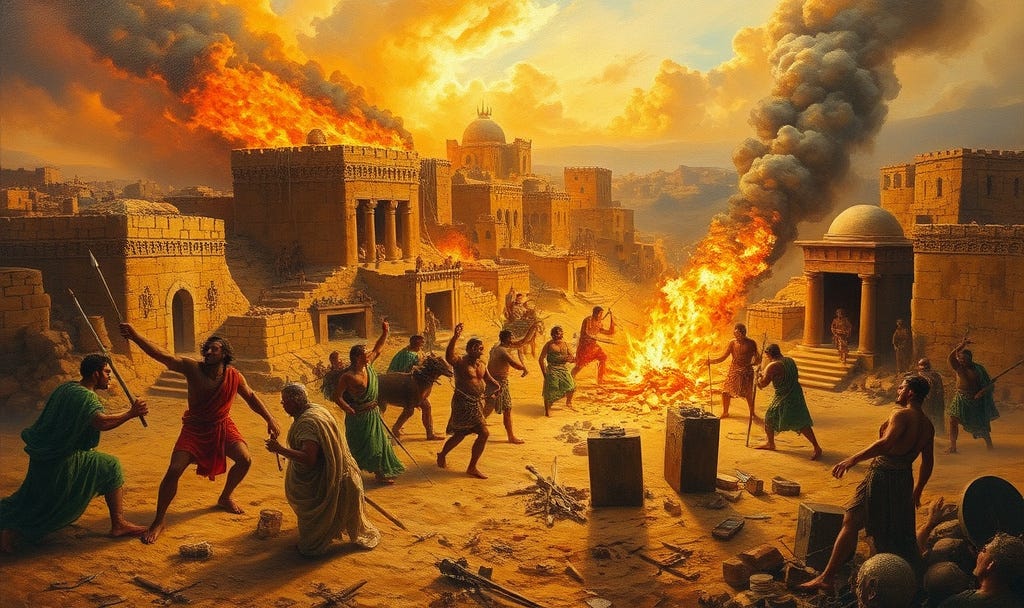
When God commanded the Israelites on what to do with the peoples already in Canaan, He did not mince words. The command was to kill them all, without exception.
God, who has promised mercy and forgiveness to Jew and Gentile alike, decreed there should be only death for the Canaanite peoples.
That doesn't sound either merciful or forgiving. It sounds harsh, angry, and even cruel.
Why was God so unforgiving towards these people?
Scripture contains only a few details, but what details there are tell us the Canaanite peoples were not nice people.
This passage in Deuteronomy speaks of their “abominable practices”, which tells us their modes of worship were offensive to God.
Leviticus 18 and 20 speak of child sacrifice to the false god Moloch, very forcefully telling the Israelites never to adopt the practice.
Leviticus 20 goes on to warn the Israelites not to defile themselves, that the land might not “vomit” them out the way it rejected the Canaanite peoples, resulting in God commanding their extinction.
This was no idle threat, as God eventually demonstrated in the closing verses of 2 Kings, with the fall of Jerusalem and the deportations to Babylon. The Israelites, God's chosen people and the instrument by which the wicked Canaanites were removed from the land, were themselves removed from the land. The land “vomited” out the Israelites, just as it had vomited out the Canaanites. They defiled themselves with sin, and were expelled from the land.
In Leviticus 19, God is quite clear on His expectations for the Israelites: they are to keep themselves holy, just as God is holy.
This is God's expectation for all who would follow Him, and keep His Law. We are to keep ourselves holy, because God is holy.
We know from various passages in Scripture that the Canaanites, as well as the Phoenicians and other ancient peoples in the Levant, did not aspire to Godly holiness. In addition to the abomination of child sacrifice, they built altars and idols to false gods, profaning their holy places with idolatry and blasphemy.
God decreed that the practices and culture of the Canaanite peoples were not compatible with what He intended for the Israelites. Where the Canaanites were sinful, idolatrous, and evil, God desired the Israelites to be holy, righteous, and good. That is God's desire for all who would follow Him.
God further decreed that there should be no compromise, no alternative to the fate God chose for the Canaanites. These peoples were guilty of great and grievous sin in God’s eyes. They had defiled themselves and defiled the land through their worship of false gods and other “abominable practices.” The penalty for their very great sin was eradication.
Whether we are considering the fate of the Canaanites or the fates of peoples today, Scripture is unequivocal. Faith and righteousness are binary propositions. We either believe, or we do not. We follow either God or Mammon. We are either slaves to righteousness or slaves to sin.
There is no third option. There can be no middle ground.
Sin can never be compatible with holiness. Idolatry can never be compatible with righteousness. Good can never be compatible with evil.
This is also how we may be sure that we all fall short of the glory of God. We are all imperfect beings, prone to errors of all kinds. God is perfect, and God's glory is perfect. The slightest imperfection in any of us is more than enough to deny us that mantle of His glory. The smallest of sins is more than enough to leave us condemned before God's perfect Law.
Our salvation—literally our saving Grace—is that God chooses to forgive, and to wash away the stains of our sins and imperfections. By God's Mercy, we are cleansed, purified, and perfected, that we may be fit to enter His Kingdom.
While we are assured of salvation and the perfect Kingdom of Heaven, we still have to live for now in a most imperfect world. We still have to make choices about right and wrong, good and evil. We have to make choices today, in the herenow, not in the hereafter.
When we make our choices, the overarching teaching of Scripture is clear: Good can never be compatible with evil. If we do not make the good choice, by definition we have made the evil choice.
We cannot compromise with sin. We cannot recast sinfulness as righteousness.
How, then, are we to navigate this imperfect world? Comes the answer: carefully, thoughtfully, and deliberately. We are called to weigh and measure our choices before choosing the right choice.
We are reminded in Leviticus 19 to reason with our neighbors, and not simply lash out at them, that we might not be tempted into sin by our emotional incontinence.
We see in the closing chapters of Judges what happens when communities and societies fail to hew to this simple commandment to use our heads before our fists. In a fit of moral outrage the Israelites very nearly eradicated the entire tribe of Benjamin, and were forced to make some very awkward moral tradeoffs to keep God’s chosen people intact.
The Apostle Paul in Romans 13 similarly advised caution and care when dealing with those who presume to wield the rod of governing authority: give everyone that which they are due, and no more.
At the same time, Paul teaches in 1 Corinthians 10:25 not to go looking for evil—”Eat whatever is sold in the meat market without raising any question on the ground of conscience.” So long as one can navigate the world with a clear conscience, one should do so.
Yet we should not pretend that we will never be confronted with evil. We should never presume we are somehow immune the temptations and vices of this world. We are not.
We will be tempted. We will be beset with evil choices as well as the evil acts of evil people.
We will be tempted. We will be forced to make choices. We will be forced to make hard choices. For every choice, God’s overarching command is clear: make the right choice, and do the right thing.
We are not called to make easy choices, or to take the path of least resistance. Very often we are called to make the hardest choice, and to take the path of greatest resistance, with the most obstacles.
Jesus Himself warned His followers—warns us even today—that doing that right thing may cost us dearly. If we truly choose to take up the cross and follow Him, that is a choice which may cost us our lives, can easily cost us comfort, wealth, and even friends.
Yet what alternative could there be? Regardless of how difficult the right path might be, what other path will lead us back to God? If we are not walking the right path back to God, by definition we are walking away from God.
If we are not doing the right thing, by definition we are doing the wrong thing—by definition we are sinning.
There is no third option. There can be no middle ground. Sin is not compatible with holiness. Idolatry is not compatible with righteousness. Good is not compatible with evil.
My prayer on every day is that I will have the courage and the vision to do the right thing in all things. My prayer on every day is that I will have the wisdom and the inspiration to show mercy and compassion towards my fellow human beings, without excusing and rationalizing away sin and wickedness. My prayer on every day is that I will have the strength and discipline to stick with the right path, no matter how big the obstacles lie ahead.
My prayer for you every day is that you also will have the courage and the vision to do the right thing in all things. My prayer for you every day is that you also will have the wisdom and the inspiration to show mercy and compassion towards your fellow human beings, without excusing and rationalizing away sin and wickedness. My prayer for you every day is that you also will have the strength and discipline to stick with the right path, no matter how big the obstacles lie ahead.
We are not called to make easy choices, or to take the path of least resistance. Very often we are called to make the hardest choice, and to take the path of greatest resistance, with the most obstacles.
When we make our choices, the overarching teaching of Scripture is clear: Good can never be compatible with evil. If we do not make the good choice, by definition we have made the evil choice.
We cannot recast sinfulness as righteousness. We cannot compromise with sin.
Good can never be compatible with evil.
One of the reasons we need salvation through Christ is that we cannot always know, in advance, the correct, good choice. We error, in our ignorance and poor calculation.
Case in point is Trump’s latest peace agreement with the IRGC. Is he taking the Christian path of mercy, forgiveness, and trust? Or is he appeasing evil, which will result in the future deaths of innocents? Only time will tell. If Trump’s intentions are good, we trust God will be forgiving of whatever errors Trump makes.
We trust God will be forgiving of ALL the errors we make - but our intentions must be in accordance with God’s law!
Bless you always, dear Peter.
The Flame on the Shore.....
https://claude.ai/public/artifacts/1d76fc79-e426-4da9-b35b-68ac156f7b23
.....pray for Translators!