

Rejoice greatly, O daughter of Zion!
Shout aloud, O daughter of Jerusalem!
Lo, your king comes to you;
triumphant and victorious is he,
humble and riding on an ass,
on a colt the foal of an ass.
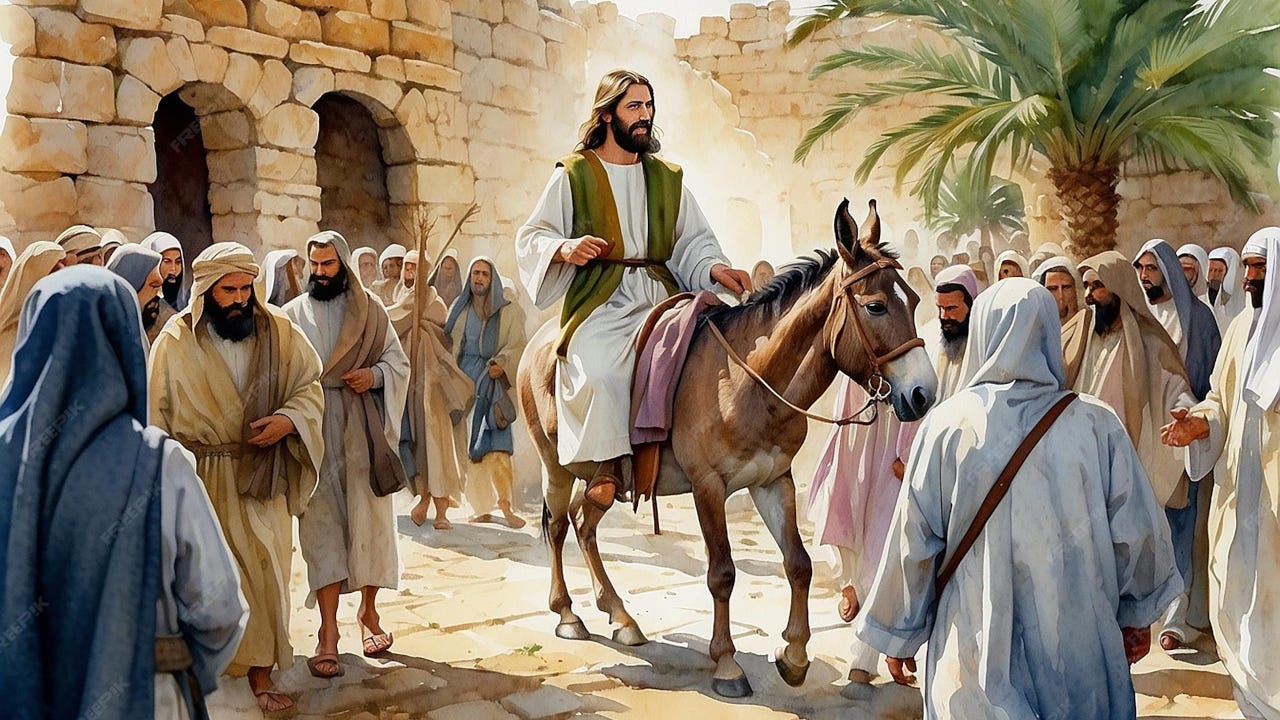
Palm Sunday is the celebration of Jesus Christ’s entry into Jerusalem, Israel’s ancient capital and the center of Jewish religious life.
In Matthew 21, we read how Jesus sent two of His disciples ahead, searching for a colt, the young offspring of a donkey, that He might ride it into Jerusalem.
As Matthew highlights, this act fulfilled the prophecy from Zechariah, and established that Jesus was meant to be King of the Jews, and the Government of Israel was meant to be on His shoulders.
The prophecy itself says much about what sort of King the coming Messiah would be: triumphant, victorious, and yet humble, riding on a colt, a foal, the young offspring of a donkey. For all the Messiah’s successes and glories, the prophecy indicates as King He would be on the same level as the people of Israel.
With this imagery, the prophecy itself recalls the ancient Mosaic commandments for kings of Israel found in Deuteronomy: the king was to be from among the people of Israel, and no foreigner not of the nation of Israel was to rule; the king was to keep his own copy of the Law, and study it daily; the king was to remember he was as much under the Law as the rest of the people.
A king who failed in these duties would soon be removed as king.
King Saul was chosen by God to be King of Israel, and when his heart hardened and he turned away from God, God withdrew from him and he lost his throne to David.
David’s son Solomon at the end of his reign turned away from God, and while God had promised not to rend the kingdom during Solomon’s reign, as soon as he passed away his son Rehobo′am was confronted with civil war and the secession of ten of the Twelve Tribes.
Kings who are arrogant, who are hard of heart, who turn away from God’s Law, do not reign long as king over God’s chosen people Israel.
The prophecy in Zechariah also comes in a passage where Zechariah is detailing the redemption of the people of Israel: how God will strike down Israel’s enemies, and restore to Israel all the blessings promised to an obedient and faithful nation.
The coming of the Messiah is thus a moment of restoration and redemption for the people, a moment when the darkness is beaten back and the light of God’s Truth illuminates everything.
The coming of the Messiah is thus also a reminder that God has not forsaken His children. He will redeem. He will restore. He will gather us back to Him in His appointed time.
The prophecy from Zechariah is rich with promise and hope. As with earlier prophecies from Isaiah and Jeremiah, it stands as a reminder that, while God will punish unholy and unrighteous behavior, when the punishment is done, the transgression is wiped away.
When the King comes, we will be forgiven.
Jesus has come, and we are forgiven.
There is another subtle truth we can glean from Jesus sending His disciples ahead to fetch the colt: Jesus was deliberate and intentional in fulfilling the prophecy from Zechariah. Jesus apparently walked most everywhere He went during His ministry here on Earth; He could just as easily have walked into Jerusalem. Yet He chose to ride into Jerusalem, and to do so specifically on the young offspring of a donkey, the precise description of the animal given in Zechariah.
As Jesus was intentional in choosing to fulfill this prophecy from Zechariah, it necessarily follows He was intentionally choosing to signal to the people of Israel that He was indeed the Messiah, and He was indeed coming as the triumphant yet humble King. Most Jewish people, and certainly all with more than a passing familiarity with Hebrew Scripture, would have recognized the prophetic implications of Jesus’ choice, even before Matthew highlighted it in his Gospel account.
By riding into Jerusalem on a colt, Jesus was telling the people of Israel that He was choosing to be the Messiah. Not only was He choosing to be the triumphant yet humble King prophesied in Zechariah, He was also choosing to do what needed to be done to redeem God’s children.
By riding into Jerusalem on a colt, Jesus was telling the people of Israel that He would triumph over the greatest enemy not just of Israel but of all people everywhere: Death itself. Jesus would go to His death on the Cross at Calvary, and after the appointed three days would arise again, fully restored to life.
Through Crucifixion and Resurrection, Jesus would defeat Death. On the day of His Resurrection, Jesus Christ would save God’s children, just as Zechariah foretold in his prophecy.
By choosing to fulfill the prophecy in Zechariah, Jesus was choosing to tell the people that the moment of their salvation was come at last, that the Kingdom of Heaven was finally at hand.
Much as the days of Advent are rich in anticipation of Jesus’ birth in Bethlehem, Palm Sunday is rich in anticipation of Jesus’ ultimate triumph—His Resurrection and our Redemption. The people of Israel knew their moment of Redemption was at hand; they knew because Jesus told them the moment was at hand. Jesus told the people of Israel the moment of Redemption was at hand when He rode a colt into Jerusalem, to the praise and adoration of the people.
On this Palm Sunday, I pray we may all be mindful of the momentous miracle Jesus Himself says is coming, the Miracle of His Resurrection we celebrate each Easter Sunday, just one week from today. On this Palm Sunday I pray we may all reflect upon Jesus’ clear intention not merely to be a triumphant yet humble King of Israel, but one who would confront and defeat Death itself, ensuring eternal life for all those who will but believe. On this Palm Sunday I pray we may all appreciate the meaning and the message of Jesus’ entry into Jerusalem on a colt, that the moment of our salvation is here at last, that the Kingdom of Heaven is truly at hand.
Jesus was intentional in choosing to fulfill this prophecy from Zechariah. He was intentionally choosing to signal to the people of Israel that He was indeed the Messiah, and He was indeed coming as the triumphant yet humble King. Not only was He choosing to be the triumphant yet humble King prophesied in Zechariah, Jesus was also choosing to do what needed to be done to redeem God’s children.
Through Crucifixion and Resurrection, Jesus would defeat Death. On the day of His Resurrection, Jesus Christ would save God’s children, just as Zechariah foretold in his prophecy.
I am concerned that Iran will use the significance of this Holy Week in the West to commit atrocities by Easter - maybe a nuclear launch on Israel, if that’s technologically possible.
I’ve also been concerned this past month about your past troubles with PTSD, Peter. I hope this new war hasn’t been triggering for you. Are you okay, dear Peter?