

Behold, an angel of the Lord appeared to Joseph in a dream and said, “Rise, take the child and his mother, and flee to Egypt, and remain there till I tell you; for Herod is about to search for the child, to destroy him.” And he rose and took the child and his mother by night, and departed to Egypt, and remained there until the death of Herod. This was to fulfil what the Lord had spoken by the prophet, “Out of Egypt have I called my son.”
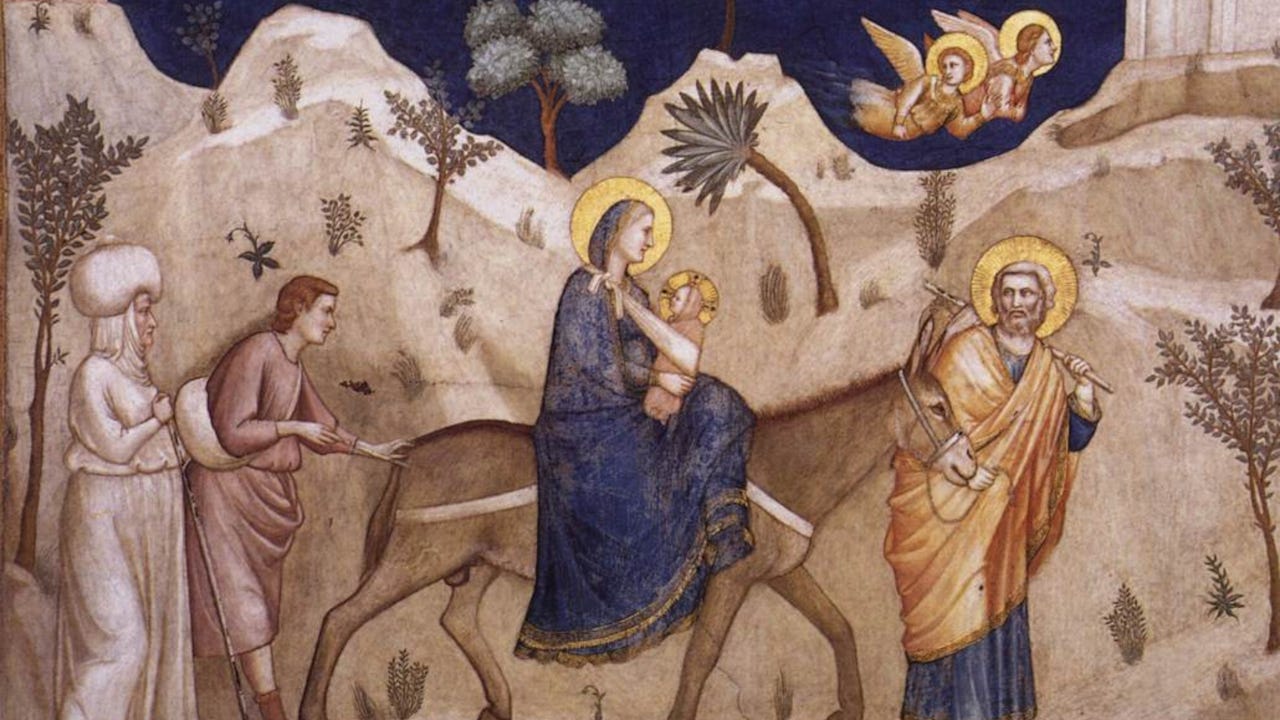
In the Catholic tradition, the first Sunday after Christmas is known as The Feast of The Holy Family. Within that tradition, the focus of this first Sunday after Christmas is on the family of Jesus—on Joseph and Mary as they fled Bethlehem with the infant Jesus to escape King Herod’s murderous rampage.
The Flight to Egypt is a remarkable image within the Nativity story. Even superficially, the juxtaposition of Herod’s degenerate, psychopathic solution to a perceived threat against Jesus' innocence and Divinity is striking. To modern sensibilities, even to ponder what Herod was willing to do to maintain his throne is to recoil in disgust and even horror. No good man, nor even most evil men, would even think to do such a thing.
We are challenged by other dimensions of this portion of the narrative as well. It is one thing for Herod to order such a categorically evil act. It is quite another for his soldiers to carry it out, which the text in Matthew suggests that they did.
When we pause to consider the obvious narrative parallels with the oppression of the Jewish people under Pharaoh and the circumstances of Moses’ birth, we can see that we should by no means presume Herod’s soldiers would blindly follow the order to kill all male infants. We see in the first chapter of Exodus that Hebrew midwives, given a similar order to kill all infant males as they are born, refused the order, recognizing it for the abomination that it is.
If the Hebrew midwives at the time of Moses’ birth could see the pure evil in ordering the killing of children, surely Herod’s soldiers could see that also. That Herod’s soldiers apparently opted to go along with such evil is a further stark comment on the spiritual state of the people of Israel. When Jesus was born, the narrative makes it clear that Israel was suffering spiritually as well as politically.
There is a temptation to infer from Matthew’s silence that the parents of Bethlehem did not put up much resistance to their sons being slaughtered. Such is purely speculation, but while we do not know if any families in Bethlehem sought to hide their infant sons from Herod, that Matthew recalls the prophecy in Jeremiah 31:15, of Rachel weeping for her children, carries the inference that any such efforts were unsuccessful.
We know from later in Matthew that the people of Israel saw Jesus as merely the son of the carpenter Joseph. That he had survived the carnage in Bethlehem does not appear to resonate with the people—at least, Matthew is silent about whatever thoughts they may have had about Herod’s slaughter of innocent infant boys.
What does it say of the people of Israel that Herod’s great evil apparently had faded from common memory? Much as with great evils in our time, evils which prompt us to proclaim “never forget”, it seems the people of Israel had forgotten about the slaughter of innocents, a lapse of memory which can only be to people’s shame.
We do not need to delve deep into Scripture to understand why Herod wanted Jesus dead. Herod saw Jesus as a threat to his throne, and Herod was determined to keep that throne. He would do whatever he must, kill whomever he must, to maintain his monarchy.
Herod was not entirely wrong to fear Jesus. Herod’s power rested on the corruption that was the status quo in Israel, and Jesus was the sign the status quo was about to fall. Change was coming to Israel, and that put Herod’s crown into the hazard.
Herod should have contemplated Jeremiah further, however, and we do well to recall Jeremiah ourselves. The slaughter of the innocents is indeed a prophecy Jeremiah makes, but further down in that same chapter, God makes a promise of a new covenant to the people of Israel. No longer would God’s Law be merely a thing of tablets and inscriptions, but God would write the law directly on the hearts of men. Our sins will be forgiven, and God will think of them no more.
This was God’s pledge in Jeremiah to mankind. Jesus came into the world to fulfill that pledge. Herod was seeking to thwart God’s pledge to mankind. Unsurprisingly, he failed.
Why would God allow His Son to be put mortal danger this way? Ultimately, we do not know. God does not share His plans with men. We are not given all of God’s designs, and we will not be given all of God’s designs.
Yet the Apostle Paul makes a striking observation in Hebrews 4:15: Jesus can empathize with the struggles men face—struggles with sin as well as struggles against evil—because Jesus has lived as men live. Jesus has experienced the weight of oppression. Jesus has lived what it is like to flee in fear for one’s life.
In those early years of His life here on earth, Jesus was protected and nurtured only by the love and determination of Joseph and Mary. We know from the Flight to Egypt that Joseph and Mary were determined that Jesus would at least have a chance to grow into manhood. They refused to be passive observers to their own child’s life.
We do not know what the journey to Egypt was like, but it could not have been an easy journey. Nor was it likely to have been a safe journey. A wrong encounter on the road could have quickly ended the entire family at the hands of bandits looking to steal whatever they possessed. That Joseph was willing to take that risk rather than subject Mary and Jesus to Herod’s cruelty is another silent testament to the kind of man Joseph must have been—in the moment of crisis Joseph rose to the challenge, making the difficult choices necessary to preserve his young family.
In the Flight to Egypt, we begin to see what must happen for God to write His Law upon the hearts of men. People have to change. People have to take chances—leaps of faith the likes of which we can never anticipate. People have to grow.
Through the hard choice to risk that journey into Egypt, God began in Joseph the transformation of writing His Law upon the hearts of all men.
It is not enough for Jesus to merely preach the New Covenant to the people of Israel. It is not enough for Jesus to tell men that their sins are forgiven. It is not even enough for Jesus to have suffered and died on the Cross at Calvary, becoming the perfect sacrifice to redeem all of mankind’s innumerable sins.
Salvation comes when people rise to the challenge of faith. When people dare to believe, dare to make the hard choices to do what is right and not merely what is easy, dare to grow, that is when people can accept God’s forgiveness. That is when people can accept that Jesus has redeemed us all. That is when people can truly be transformed, born again into a new life embracing God, seeking righteousness, striving always to rise past our human weaknesses and imperfections.
By making the hard choice to risk the journey into Egypt, Joseph acted to preserve the infant Jesus, to sustain Him until the time of His ministry was at hand. By making the hard choice to risk the journey into Egypt, Joseph made possible Jesus’ sacrifice on the Cross at Calvary, and His Resurrection.
If Joseph does not act, Jesus’ ministry on Earth does not happen. If Joseph does not act, Jesus’ Crucifixion does not happen. If Joseph does not act, Jesus’ Resurrection does not happen.
On this first Sunday after Christmas, I pray people everywhere can be inspired by Joseph and Mary, and the love they must have had for the infant Jesus. On this first Sunday after Christmas, I pray people everywhere can find strength and courage in the example of Joseph and Mary to rise to the challenges within their lives, making the hard choices necessary to stand for what is right. On this first Sunday after Christmas, I pray people everywhere find the faith to act boldly and righteously, trusting in God for the outcome, that God may write His Law upon their hearts.
Joseph acted to preserve the infant Jesus. By making the hard choice to risk the journey into Egypt, Joseph made possible Jesus’ sacrifice on the Cross at Calvary, and His Resurrection.
Through the hard choice to risk that journey into Egypt, God began in Joseph the transformation of writing His Law upon the hearts of all men.
I have wondered what else the angel might have told Joseph. Did the angel give a “knowing” of some sort to Joseph that his child was the Messiah? Was there something imparted that gave Joseph extra resolve and fortitude in saving Jesus? Did Joseph act purely from fatherly love, or did he have a sense of God working through him? Maybe I’ll find out in the afterlife.
For the present time, we must act on faith.
Peter, you state, " That Herod’s soldiers apparently opted to go along with such evil is a further stark comment on the spiritual state of the people of Israel. When Jesus was born, the narrative makes it clear that Israel was suffering spiritually as well as politically."
It appears to me that they are still suffering spiritually as well as politically and have learned nothing, as the genocide of Palestinians, children as well, continues today. The Zionists in control have never accepted Jesus as the Savior.