

Now the time came for Elizabeth to be delivered, and she gave birth to a son. And her neighbors and kinsfolk heard that the Lord had shown great mercy to her, and they rejoiced with her. And on the eighth day they came to circumcise the child; and they would have named him Zechari′ah after his father, but his mother said, “Not so; he shall be called John.” And they said to her, “None of your kindred is called by this name.” And they made signs to his father, inquiring what he would have him called. And he asked for a writing tablet, and wrote, “His name is John.” And they all marveled. And immediately his mouth was opened and his tongue loosed, and he spoke, blessing God. And fear came on all their neighbors. And all these things were talked about through all the hill country of Judea; and all who heard them laid them up in their hearts, saying, “What then will this child be?” For the hand of the Lord was with him.
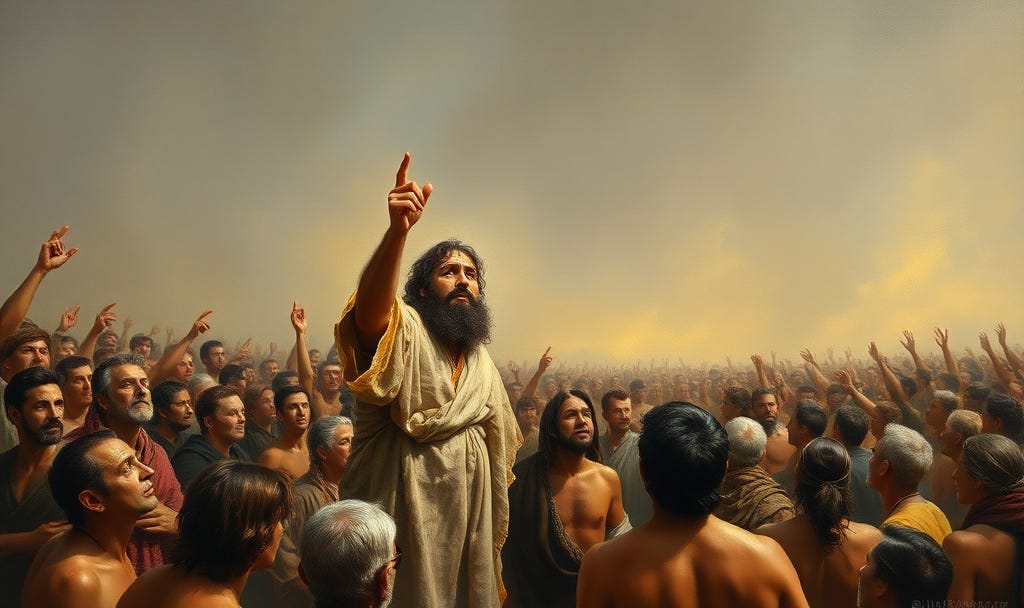
How should we approach John the Baptist?
We know from Luke that his mother Elizabeth was a cousin to Mary, the mother of Jesus. We know that the angel Gabriel told his father Zechari'ah Elizabeth would conceive and bear a son. We know Zechari’ah was rendered mute for doubting the power of the Holy Spirit to make Elizabeth fertile, for she was believed to be barren.
We know that John had a natural gift of perceiving when he was in the presence of Jesus, for we are told that John “leapt” in his mother’s womb when Mary, while pregnant with Jesus, came to visit.
We know that John would grow up to become an itinerant preacher, walking the length and breadth of Judea preaching the imminent arrival of the Messiah.
This last is important, because John occupies a special place in the Gospel narrative. Long before the Apostle Peter blurted out that Jesus was the Christ, John would herald Him as the “Lamb of God”. John would then baptize Jesus to mark the start of Jesus’ ministry here on Earth.
While Jesus is of course the essential figure in the Nativity story, John the Baptist is hardly insignificant. John was significant enough to warrant the angel Gabriel visiting his father in the Holy of Holies. John was significant enough that God chose to make the barren Elizabeth fertile that she might give birth to him.
John himself declared that he was the “voice in the wilderness” foretold by the prophet Isaiah, the one calling the nation of Israel to repentance, and to make ready for the coming of the Messiah.
Isaiah is not the only Old Testament prophecy about John the Baptist. In Malachi, the last book of the Old Testament, God warns the people of Israel that He will first send a messenger, and then He will come to His temple in Jerusalem. In the closing verses of Malachi, God expands on that by stating He will send Eli′jah the prophet to the people just before the Messiah arrives.
The Old Testament quite literally ends on a prophecy of John’s eventual coming.
It is perhaps a fitting bookend that Jesus would begin His ministry by going to John to be baptized.
We do well also to note that John is the first figure in the Bible to perform baptisms, instituting them as a ritual of the repentance to which he called the Jewish people. Jesus commanded His disciples to carry on the ritual in the Great Commission, but the ritual comes into the Gospel narrative through John.
John tells the Jewish people that the Messiah is coming, and that the Kingdom of God is at hand. John warns them about the dangers of hypocrisy, of agreeing to baptism and the rituals of repentance while continuing to lead wicked and sinful lives.
John is not Jesus, and his followers could not be given the authority Jesus would give to His disciples, but John nevertheless stands as the prologue, the literal introduction to Jesus’ message and ministry here on Earth.
John’s place in the Gospel narrative, and the way his birth runs in parallel with that of Jesus, illustrates how the tapestry of God’s plan unfolds. Jesus is not abruptly thrust center stage among the Jewish people. Rather, His time on Earth is prepared. Mortal men such as John do important work in that preparation. Just as prophets such as Isaiah and Malachi would carry the word of God to the nation of Israel, John calls Israel to “make straight in the desert a highway for our God.”
John therefore also stands as a reminder that God works through people. Even Jesus did not rely solely on His own sermons and teachings to spread His ministry, but sent His disciples out to carry His message to the whole of the Jewish people.
God calls people to be the instruments of His divine Will. Just as God called Isaiah and Malachi to be prophets, God chose John to be the preparation for Jesus.
Why does God choose to work His will through mortal men, with all their flaws and imperfections? We do not know. We only know that God chooses to work His will through mortal men.
God certainly did not need John to announce the coming of the Messiah. Angels such as Gabriel could easily have brought that message. Angels could have delivered the prophecies of Isaiah or Malachi—but God chose men.
God’s Will is that God’s plan involves men. Angels have their place, but so did Isaiah, so did Malachi, and so did John.
Angels have their place in God’s plan, but so do you, so do I, so do we all.
Jesus came into the world to save mankind from our sins. First through His ministry, and finally through His sacrifice on the Cross at Calvary, Jesus redeems us all.
The sacrifice was all Jesus. The message was entirely of Jesus. Yet the messengers were His disciples, and the prologue was John. Ordinary men were chosen by God to serve extraordinary roles in the greatest story of all—the salvation of mankind.
On this the third Sunday of Advent, I pray we may all enjoy continued insight and wisdom into the powerful role John the Baptist played in the Gospels. On this the third Sunday of Advent, I pray we may all see in John the Baptist a reminder that God works His Divine Will through people, even moreso than angels. On this the third Sunday of Advent, I pray we may all be inspired by the figure of John the Baptist, that we may rise to whatever role God has for each of us in His plan for the world.
God certainly did not need John to announce the coming of the Messiah. Angels such as Gabriel could easily have brought that message. Angels could have delivered the prophecies of Isaiah or Malachi—but God chose men.
Angels have their place in God’s plan, but so did John. So do you, so do I, so do we all.
God works in mysterious ways, as we all know. I believe that frequently, this is through us ordinary people. If you encounter a person, assume there is a way for you to minister to him, through caring, companionship, advice, alms, or whatever seems called for. Especially now, during the dark days of winter, when so many have the Christmas Blues, assume this person is in need of good cheer, and be that good cheer.
I have a Christmas tradition that no one knows about (until now). Every year, I decorate a different living pine tree in the parkland near my home. The little tree becomes a Christmas tree, covered with traditional sparkly ornaments. As the days pass, I can tell how many people take delight in it by the many boot tracks encircling it in the snow. I know that little kids are seeing the magic in it. But I do this especially because I know that many people go for a forlorn walk when they are feeling blue. One person is sad because it’s the first Christmas since her mother died. This other person is despairing because he’s lost his job and now can’t buy his children the toys they want. The reasons for sadness are endless. But a person rounds a bend on his walk, and suddenly there is an old-fashioned, non-commercial sparkling Christmas tree, signifying hope and God’s love. I’ve seen the smiles lighting up on somber faces, the lifting of heads as they see a bright sign. And I am grateful that I can provide this hope and comfort.
You can, too - everyone can. It’s the season of peace on earth, good will towards men. Be the good will!