

Then let us no more pass judgment on one another, but rather decide never to put a stumbling block or hindrance in the way of a brother. I know and am persuaded in the Lord Jesus that nothing is unclean in itself; but it is unclean for any one who thinks it unclean. If your brother is being injured by what you eat, you are no longer walking in love. Do not let what you eat cause the ruin of one for whom Christ died.
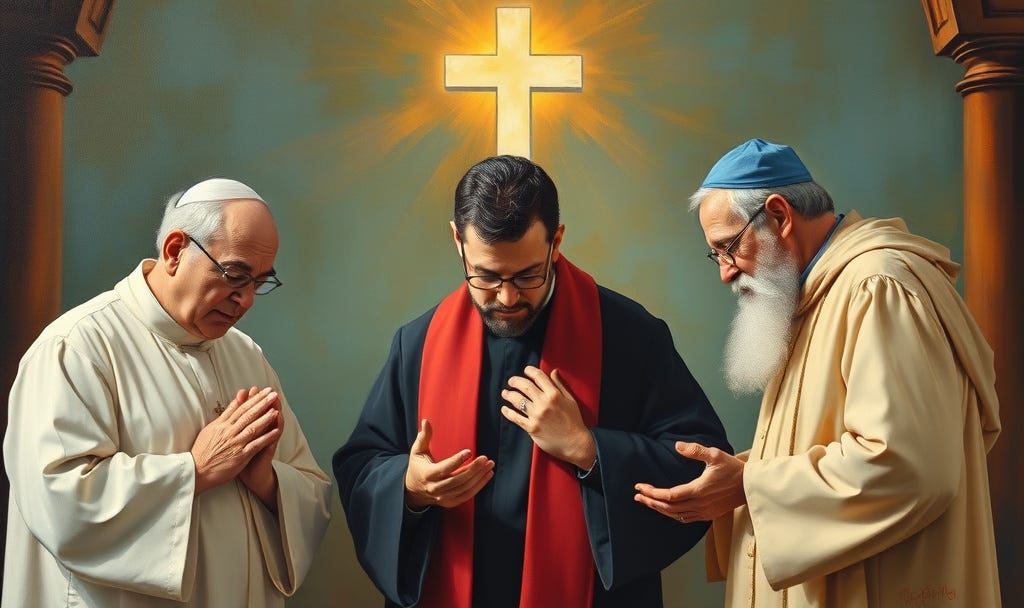
Is a Roman Catholic more “Christian” than a Protestant?
Are Evangelicals more “Christian” than Presbyterians?
Perhaps the better question is “who decides?”
Who on earth today is qualified to decide whether a person is a genuine follower of Christ or not?
I am not speaking of people whose words, actions, or stated beliefs clearly contradict what is clearly stated in Scripture. People who revel in hatred can hardly claim to be following Jesus’ teaching from the Sermon on the Mount to “love your enemies and pray for those who persecute you.” People who put things like wealth, or a career, ahead of doing what is right and righteous are indisputably serving Mammon and not God.
A person who rejects or ignores Christ’s teachings by definition cannot claim to be any sort of “Christian.” There is no real debate to be had on that point.
What about those who claim that women should not be pastors or lead churches, and can argue the point with Scriptural support? Are they “Christian”?
What about those who make a point of using “Yeshua” rather than “Jesus”, arguing that such a transliteration of the original Hebrew name is more respectful than the anglicized version of the Greek transliteration of the original Hebrew name? Are they “better” Christians than those who use “Jesus” to refer to the Son of Man?
My honest answer to such questions is simply this: I don’t care.
I really don’t care about abstract theologies. Debates over ideas such as “dispensationalism” do not interest me in the slightest.
My priorities are how to live out God’s Law and God’s Will in real life. The description I give “Peter’s Proverbs” is exactly that: one man’s thoughts on Christian living. There is especial emphasis on “living”.
I do consider myself to be a Christian, although there have been more than a few people who have told me I am not, usually in a fit of self-righteous indignation. Frankly, I also don’t care about their opinions of me.
As a Christian, my goal is simple: I want to live a good life. I want to do the right things, focus on the right things, aim for the right things. When the Son of God comes again to judge the world, as Jesus foretold in Matthew 25, I want to be among those placed on His right hand and not on His left. I want to inherit the Kingdom of God. I want to enter Paradise.
Does that make me a “good” Christian? Does that make me a hypocrite?
I have no idea. I know I have been called both by people firmly convinced they were in the right.
I also know that other people using “Yeshua” rather than “Jesus” has no bearing on how I pray, how I worship, or how I make moral choices about my life. I know that people who will not attend a worship service led by a woman have no involvement in my choice either to attend or not attend such a worship service.
What other people believe is simply not relevant to what I believe. Regardless of whether we agree or disagree, what I believe is what I believe, neither more nor less. The lessons I take from Scripture are what I take from Scripture, neither more nor less. My ideas on how people can put those lessons into practice are my ideas, neither more nor less.
The same holds true for others. Their beliefs, their apprehensions of Scripture, and their ideas are theirs, neither more nor less. If someone presents me with an idea that resonates, I will incorporate it into my own view of things in whatever manner seems fitting, but that choice of mine neither alters nor validates their ideas. It merely means I choose to embrace an idea. I might just as easily choose to disregard that idea.
No matter what any of us believe, it is incumbent upon each of us to decide how to act on our beliefs. It is incumbent upon each of us to make choices, to determine for ourselves what is right and what is wrong. As the closing verse of Judges poignantly reminds us, no one can make our choices for us. We might make good choices, we might make poor choices, but we are required to make our own choices. There is no second option in that.
As everybody has to choose for themselves, it is inevitable that we are going to disagree with each other’s choices. No two people will always agree on everything.
What should I do when someone makes a choice with which I disagree? At what point does that disagreement command me to call out their choice as evil, and to publicly oppose that choice?
What should I do when disagreement does not command me to call out their choice as evil?
In all cases, I have to choose when doing the right thing means calling out other people’s evil choices and when doing the the right thing means remaining silent and refraining from unnecessary conflict.
At work I may encounter people’s lifestyle choices I personally believe are sinful. In spite of what I believe I still have to work with those people. There are those at work I find superficial and even annoying, and while I would not choose to be around them outside of work, at work I have an obligation to work with them in order to do my job.
In or out of work, in or out of church, I am called—as we are all called—to love my neighbor as I love myself.
In or out of work, in or out of church, I am called—as we are all called—to show mercy, grace, and compassion to others.
Even when we disagree with someone, we are called to give them grace. We may not like their politics, their lifestyle, or some particular of their religious practices, yet we are still called to give them grace. Giving grace is not an option. Giving grace is a duty, a duty we owe both to God and to ourselves.
While we are called to choose right over wrong, and good over evil, we are also called to choose peace over war. So long as we are not being compelled to accept that which is morally wrong, we are called to be reconciled to one another.
This is where we should draw the boundary: so long as a person’s choices do not seek to coerce bad choices from us, we should not seek conflict with them. So long as we remain free to choose right and wrong for ourselves, there is little cause for war. To retain that freedom, we must allow others the opportunity to choose right from wrong, and to do right or wrong.
So long as we are not being ourselves compromised, we are well advised to look for compromise and cooperation.
That is the only way people can ever come together to form healthy and sustainable communities. That is the only way people can ever build a healthy and sustainable society. That is the only way people can ever honor God and put God’s Law into daily practice.
My prayer this day is that I will always find ways to give others grace despite our disagreements. My prayer this day is that I will not let disagreement become a stumbling block to extending mercy and compassion to everyone. My prayer this day is that I will always look for peace rather than war.
My prayer for you this day is that you also will always find ways to give others grace despite disagreements. My prayer for you this day is that you also will not let disagreement become a stumbling block to extending mercy and compassion to everyone. My prayer for you this day is that you also will always look for peace rather than war.
So long as a person’s choices do not seek to coerce bad choices from us, we should not seek conflict with them. So long as we remain free to choose right and wrong for ourselves, there is little cause for war. To retain that freedom, we must allow others the opportunity to choose right from wrong, and to do right or wrong.
So long as we are not being ourselves compromised, we are well advised to look for compromise and cooperation.
That is the only way people can ever come together to form healthy and sustainable communities. That is the only way people can ever build a healthy and sustainable society. That is the only way people can ever honor God and put God’s Law into daily practice.
People will believe as they will believe. I believe as I believe. We will not always agree with one another, but we are always called to give grace to one another.
Your words echo the most basic, underlying premises of our Founding Fathers, Peter. Because each person has a unique understanding of God, we must have freedom to believe and think in accordance with our understanding. We must be free to follow our conscience, and we must allow others to follow their own spiritual path, or we are not free. Until “cancel culture” took hold of America, people agreed upon this basic premise. We need to get back to it!
Bless you for your writings, Peter!
Good one today, Peter. These thoughts are very close to my outlook as well. Linking of course @https://nothingnewunderthesun2016.com/