

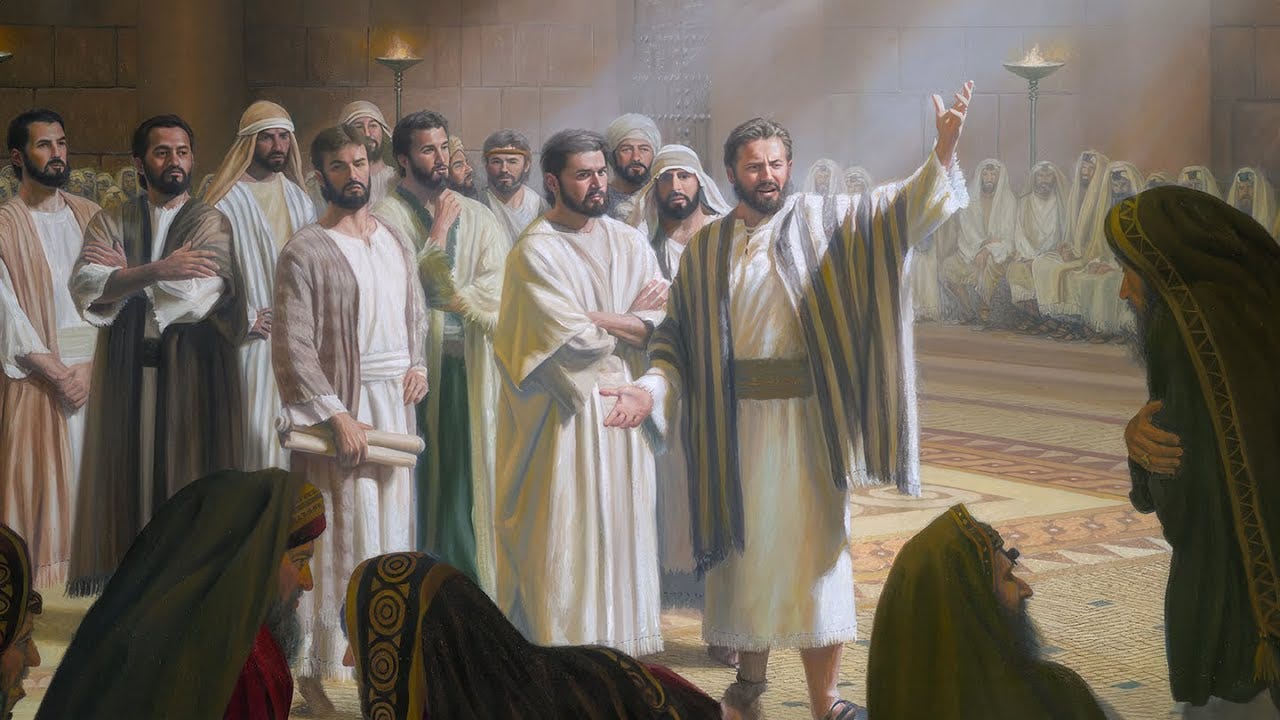
And when they had brought them, they set them before the council. And the high priest questioned them, saying, “We strictly charged you not to teach in this name, yet here you have filled Jerusalem with your teaching and you intend to bring this man’s blood upon us.” But Peter and the apostles answered, “We must obey God rather than men. The God of our fathers raised Jesus whom you killed by hanging him on a tree. God exalted him at his right hand as Leader and Savior, to give repentance to Israel and forgiveness of sins. And we are witnesses to these things, and so is the Holy Spirit whom God has given to those who obey him.”
Authority.
It has been my experience that few words are as inflammatory and divisive among Christians as the word “authority.” I am convinced there is no more certain way to attract the ire of believers from all denominations than to advance the simple assertion that God has all authority, while men have none.
Christians from all denominations will point to numerous passages from Paul’s letters especially, showing Scriptural basis for human claims of authority. They will quote them quite accurately, and insist these texts are conclusive proof that Jesus ordained the leaders of His church have authority over the church.
Is this really so? When we consider these same passages in the context of the whole of Scripture, do claims of human authority survive scrutiny?
I say they do not. As I have argued previously, ecclesiastical office alone is inadequate to establish anyone’s authority to declare what is and is not sound doctrine. The title never makes the man. Rather, it is the man who, by his conduct and his character, gives whatever office he holds its gravitas and influence.
Let us be clear what we mean when we say “authority”. As the term is defined in Merriam-Webster, “authority” is “power to influence or command thought, opinion, or behavior.” Authority is the legally or organizationally recognized power to command, the power to say “do” with no further explication or rationale.
Do pastors, priests, and popes possess such authority? Do they possess the power to “command thought”?
The Roman Catholic Church certainly teaches that the Pope is infallible when he proclaims official church doctrine. There can be few claims of authority more categorical and definitive than that.
We should also note that a number of Protestants will defend similar claims of authority when citing various notable Protestant ministers and theologians in defense of a particular doctrine.
However, before we blindly accept claims of human authority, we do well to note the Greek word that is translated as “authority” throughout the New Testament: ἐξουσία (”exousia”).
As is generally the case with translated words, ἐξουσία is not the literal equivalent to “authority”. The challenge in all translation is to find the word in one language that best fits a word in another language in a given context.
A nuance to ἐξουσία that can easily get overlooked is that it can mean “delegated influence”.
As a noun, a “delegate” is one who acts on behalf of another. As a verb it means to assign responsibility to act on behalf of another. “Delegated authority” is an assigned responsibility to exercise the authority of another, acting in their stead. When authority is delegated, the person to whom it is delegated is authorized. The authority they wield is not their own, but the authority of the one doing the delegating.
While this nuance is frequently overlooked, it is essential for a proper understanding of how authority actually works. In law, “actual authority” describes the scope of what one person has been authorized to do on behalf of another. When actual authority is exceeded, contractual relationships break down (and litigation frequently ensues). As a matter of both law and common sense, there is no authority to act beyond the scope of what has been authorized.
We see this same depiction of how authority actually operates in John 19, when Pontius Pilate confronts Jesus, claiming the power (ἐξουσίαν) to release or to crucify Jesus. Jesus rebukes Pilate, replying “You would have no power over me unless it had been given you from above; therefore he who delivered me to you has the greater sin.”
Jesus explicitly told Pilate his authority as Roman governor of Judea existed only to the extent it came from God, and that whatever authority God had not delegated to him was not Pilate’s to wield.
Jesus rejected to Pilate’s face the idea that Pilate possessed any authority of his own.
We see delegation being expressed again in Romans 13, when the Apostle Paul teaches that we should be subject to “the governing authorities. For there is no authority except from God, and those that exist have been instituted by God.” That is a literal description of what delegation is.
We should note also that Paul qualifies this in Romans 13:7, saying that we should “Pay all of them their dues, taxes to whom taxes are due, revenue to whom revenue is due, respect to whom respect is due, honor to whom honor is due.”
Respect for and compliance with any person wielding authority is necessarily delimited by that person adhering to God’s Law and following God’s Will. A person outwardly charged with a delegation of authority acting in defiance of God’s Law and against God’s Will has gone beyond the scope within which they have any claim to respect or compliance.
The prophet Hosea warned the Levitical priests explicitly that their neglect of God’s Law was a condemnation upon them, because they had not instructed and guided the people of Israel as they should have. They ventured outside the scope of what they had been tasked with doing by God, and had led the people astray by their misconduct.
If the priests had authority of their own, they would not be under condemnation for straying from what God required of them. Because the Levitical priests were called to act only in accordance with how they had been authorized in Leviticus, their failure to keep to those boundaries became their particular sin and their particular downfall. In particular, the priests were explicitly charged with teaching the people of Israel all the laws God gave to Moses, and in Leviticus 4 they were charged with particular atonement when they sinned and went against God’s Law.
Leviticus 4 also makes it clear that the people of Israel were obligated to follow God’s Law no matter what the priests did or did not do. Unwitting sins by the people were still sins, and they were still called to atone for them. Priestly misuse of delegated authority did not inoculate the people from the consequences of their sins. The priests were charged with teaching all the laws God gave to Moses, but the people themselves were still responsible for knowing that law.
Pastors, priests, and popes are charged with teaching God’s Law and God’s Word, but we are responsible for knowing God’s Law and God’s Word for ourselves.
As we are reminded twice in Judges, each person is responsible for judging right and wrong and choosing accordingly, and in Deuteronomy 24:16 we can see that each of us is to be held to account for our sins, not someone else. We cannot point to a pastor, priest, or pope and say “he said it was okay.” If what we do goes against God’s Law, that sin is on our head alone, and the consequences are ours to bear alone.
In Jeremiah 6:13, we see a warning to the Israelites that they will bear consequence for not following God’s Law, that following the leadership of corrupted and sinful kings and priests is not an excuse and will not save them from God’s wrath.
This warning we see again in Malachi 2, where the prophet rebukes the kingdom of Judah for having gone against God’s wishes. That the Levitical priests had failed the people did not save the people from consequence for their own sins.
Thus when in Hebrews 13:17 Paul teaches that we should obey our leaders, we must step back and note what Paul says earlier in that same chapter about those who lead, that how they live their lives should show themselves an example to others. The leadership Paul describes is not an arbitrary wielding of authority, but of setting the good example. One who claims leadership but is not setting the good example is not someone anyone should be following.
We see this same framing surrounding Paul’s charge to Titus regarding the deputing of elders and church leaders in Crete. Those who would lead must set the good example and follow the teachings found in Scripture. Those who would lead must have the strength of character to defend those teachings, and to call out those who attempt to confuse and confound with poor doctrine, but before they can lead they must show they are truly following God’s Law and are truly teaching God’s Word.
In Titus 2, Paul makes it again quite clear that leadership ultimately is always by example, and that example is fidelity to God’s Word.
The Apostle Peter also champions the idea of leading by example. In 1 Peter 5 he exhorts those who would be elders of the church to specifically lead by example. Domination and command are rejected by Peter as leadership attributes, who lifts up instead commitment and faithfulness.
We should note that in 1 Timothy 3, Paul’s description of who is qualified to stand as bishop or deacon in the church is again a question of setting the good example. Such ἐξουσία as the bishop or deacon is given to exercise is earned, and is therefore delimited.
Time and time again, when the Apostles teach of respecting those in positions of leadership, that respect is predicated on the leaders having earned it through the example of their own lives, and it is always conditioned upon the leader staying faithful to God’s Word.
Biblical leadership is described as ἐξουσία, and is translated as “authority”, but it is never a rule by decree, nor is it ever a power to lord over others. Biblical leadership draws heavily on the nuance in ἐξουσία of delegation, and is predicated on leaders being faithful to God’s Word, God’s Will, and God’s Law.
We can see in Jesus’ own teachings that this must be so. In Matthew 20 He specifically teaches that those who would lead are to serve rather than be served. That model of leadership Jesus references again in Matthew 23, when after calling out the Pharisees for their arrogance and hubris, He teaches His disciples to humble rather than exalt themselves, not claiming title of either “rabbi” or “master.” That teaching is found again in Mark 10: “whoever would be first among you must be slave of all.”
Biblical leadership is a duty. Biblical leadership is an obligation, and a sacred one. Biblical leadership is never a right.
Biblical leadership is a privilege, by which good and faithful men and women serve the church, serve the community, and serve God. That is the model of ἐξουσία described throughout the New Testament.
As described throughout the New Testament, ἐξουσία is a delegation from God, a calling by God, and an obligation to God.
Is the man who stands on his “authority” following that model of ἐξουσία? Is the man who is prideful of his “authority” measuring up to Biblical standards for wielding ἐξουσία?
That is a question each of us must answer for ourselves, and that is a question each of us is charged to answer for ourselves. What was true at the close of Judges is true today: each of us must choose right and wrong for ourselves, and we must act accordingly. There is no delegation of moral accountability. If we choose to follow a man, we will be held to account for that choice, and if we choose not to follow, we will be held to account for that choice also.
If we accord a measure of leadership to another, common sense and Scripture say we should listen to what they say. Common sense and Scripture also say we should think critically about everything they say, and put it aside if we conclude that what they say is wrong. That discernment is always ours, and cannot be overridden by any other person.
My prayer this day is that all people everywhere will give thought to what authority truly is, and what it truly is not. My prayer this day is that all people everywhere will recognize that ἐξουσία—authority—is a delegation from God, and an obligation to God. My prayer this day is that all people everywhere will recognize that ἐξουσία exists among men only so long as those claiming to wield ἐξουσία are in truth adhering to God’s Law and following God’s Will—and that is always upon each of us to determine that for ourselves.
Biblical leadership is a privilege, by which good and faithful men and women serve the church, serve the community, and serve God. That is the model of ἐξουσία described throughout the New Testament.
Biblical leadership is a duty. Biblical leadership is an obligation, and a sacred one. Biblical leadership is never a right.
ἐξουσία is a delegation from God, a calling by God, and an obligation to God.
Because all authority belongs to God. No authority belongs to men.
“All Scripture is given by inspiration of God, and is profitable for doctrine, for reproof, for correction, for instruction in righteous.” - 2Timothy 3:16
Turn your thoughts to God and to His Word, and do not rely on the fallibility of man. You are right as usual, Peter. Bless you today and always!