

And in that region there were shepherds out in the field, keeping watch over their flock by night. And an angel of the Lord appeared to them, and the glory of the Lord shone around them, and they were filled with fear. And the angel said to them, “Be not afraid; for behold, I bring you good news of a great joy which will come to all the people; for to you is born this day in the city of David a Savior, who is Christ the Lord. And this will be a sign for you: you will find a babe wrapped in swaddling cloths and lying in a manger.” And suddenly there was with the angel a multitude of the heavenly host praising God and saying, “Glory to God in the highest, and on earth peace among men with whom he is pleased!” When the angels went away from them into heaven, the shepherds said to one another, “Let us go over to Bethlehem and see this thing that has happened, which the Lord has made known to us.” And they went with haste, and found Mary and Joseph, and the babe lying in a manger. And when they saw it they made known the saying which had been told them concerning this child; and all who heard it wondered at what the shepherds told them. But Mary kept all these things, pondering them in her heart. And the shepherds returned, glorifying and praising God for all they had heard and seen, as it had been told them.
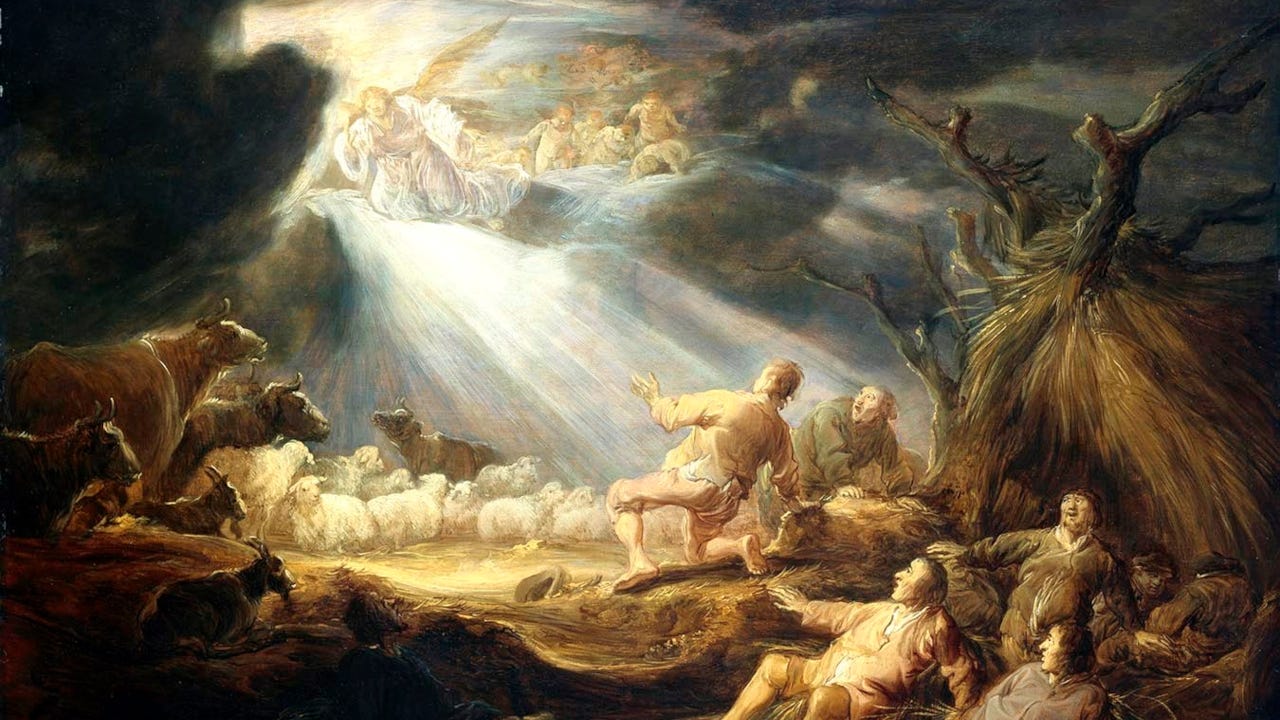
The shepherds guarding their flock that first Christmas were obviously quite affected by their angelic visitation. They abandoned their flock for a time just to see the infant Jesus—a risky move for any shepherd, as the loss of the flock would be ruinous.
We can easily understand why the shepherds were so moved. At least, we think we understand. If a luminous being descended from the night sky and spoke to you or I, “moved” would be the mild description of how we would likely react! Such things just don't happen, nor did they happen routinely even in ancient Judea.
Yet we should ask ourselves why the sign told the shepherds by the angel seemed so remarkable? Why was it a sign from God that Jesus would be laying in a manger?
We are accustomed to viewing a Nativity scene with a certain reverence. We know the child in the manger is the Christ.
Strip that knowledge away. How remarkable is the Nativity scene then? How much awe would we have if we came upon Mary and Joseph, with the infant Jesus, in the present day? If we saw them, not in a barn, but huddled under a bridge in a homeless encampment, would we think to ourselves that the child was King of Kings, and Lord of Lords?
We would not. We would probably think poorly of Joseph and Mary, for being “homeless”. We would likely look down on them, to our eternal shame.
One can argue that Jesus laying in a manger was an eternal shame to the people in Bethlehem. Mosaic Law commands, in Leviticus 19:34, hospitality and generosity to the traveler.
How much hospitality did the people of Bethlehem show the very pregnant Mary? Not much. They did not make room for her. We do not read in Luke of the women of Bethlehem coming to assist Mary with childbirth. Luke mentioned the women attending on the birth of Jesus' cousin John the Baptist, which makes the silence regarding who attended Jesus' birth disturbing, if not damning.
Can there be a clearer depiction of a society consumed with itself than Mary having only a manger in which to place the infant Jesus? How much hardness of heart is needed to tell a woman going into labor “we’re full, we have no place for you”?
Is that a society we want for ourselves, not just as Christians, but as human beings? For myself, I do not want to be in such a society.
Is that the society we have? We need only turn on the evening news to see that it is.
The shepherds could not turn on the evening news, but they could certainly see the state of the world around them. They could see the corruption of the Pharisees, the arrogance of the Romans, and the cynicism of ordinary people.
Jesus laying in a manger captures all that in a single tableau. Joseph and Mary were in Bethlehem because of a Roman edict. The Mosaic Law regarding how to receive travelers had become twisted and discarded, as the Pharisees did time and again with the Law. People were too wrapped up in their own lives to make space for a young pregnant woman about to deliver her first child.
The shepherds that first Christmas would have at least been aware of such things. They would have seen Jewish society was not heading in a good direction.
Yet the angels presented Jesus in a manger as a sign. From that manger, the Jewish people would be shown a better path. From that manger would come hope, redemption, salvation.
Jesus in the manger was a sign that the low point had been reached. A change had started, one which would culminate in Jesus’ death on the Cross at Calvary and subsequent Resurrection.
Did the shepherds realize this? That would have been unlikely.
Yet the shepherds would have needed a message of hope then, just as people need messages of hope today. A sign that the world was about to get better would have been as welcome to the shepherds as it would be to people today.
That first Christmas, an angel descended from on high to deliver just such a message of hope, with a chorus of angels singing praises to God the Father and God the Son. That first Christmas, an angel told those shepherds that message of hope was a child, wrapped in swaddling cloths, laying in a manger.
Were the shepherds eager to receive such a message of hope? It takes no great stretch of imagination to believe that they were.
Are people eager to receive such a message of hope today? Certainly some are.
We need no signs, no prophecies, no revelation from Scripture to see that the world is not on a good path. People are angry, cynical, divided, and not doing at all well. Our youth are too often not thriving. Our elderly are too often abandoned. Our vulnerable are exploited, and our strongest made weak.
Today, as on that first Christmas, the world needs a message of hope.
Today, as on that first Christmas, the world has that message—a child, wrapped in swaddling cloths, laying in a manger.
My Christmas prayer is that people everywhere hear that message of hope. My Christmas prayer is that this night people everywhere hear God's call to us. My Christmas prayer is that people everywhere will experience the turning point in their lives, and a rebirth into new and everlasting life.
Today, as on that first Christmas, the world needs a message of hope.
Today, as on that first Christmas, the world has that message—a child, wrapped in swaddling cloths, laying in a manger.
Merry Christmas.
Grace and peace to you Amigo,
CHRIST is Born, Glorify Him!
➕ IC XC Nika! ➕
“Today, as on that first Christmas, the world needs a message of hope.”
Thank you for relaying the message of hope, Peter. You’re making a difference. Bless you always!